Aamis/Ravening (2019)
Aamis/Ravening
November 19, 7pm, IU Cinema
Free but ticketed
Ravening follows the story of Nirmali, a married pediatrician, who encounters Sumon, a young PhD student researching meat-eating practices in northeast India. Their shared culinary interest turns into a unique and intense bond as they explore unusual meats together. What begins as a seemingly innocent friendship spirals into forbidden obsession with ever more exotic meats. As Nirmali's tastebuds grow more adventurous, their relationship takes a dark and bizarre turn. [107 min; drama, horror, romance; Assamese with English subtitles]
A Q&A with Nishant Buragohain (doctoral student, Dept. of Geography) and Suyash Kumar Neupane (doctoral candidate, Dept. of Folklore and Ethnomusicology) will follow the screening.
"It's inventive, provocative and truly genre-defying." — Anupama Chopra, Film Companion
"The last 15 minutes of Aamis deliver a knockout punch that will leave viewers feeling both nauseated and emotionally haunted over the choices made in the name of love." — Carla Hay, Culture Mix
"Aamis is a masterfully told macabre romance, strongly influenced by Nagisa Oshima and Wong Kar-Wai." — Bedatri D. Choudhury, Vague Visages

Learn more about Assam and its cuisine (as well as that of its Northeastern neighbors) by exploring the suggested videos and readings.
-
Assamese Cuisines: Oasis of Flavors (Aatreyi Dutta)
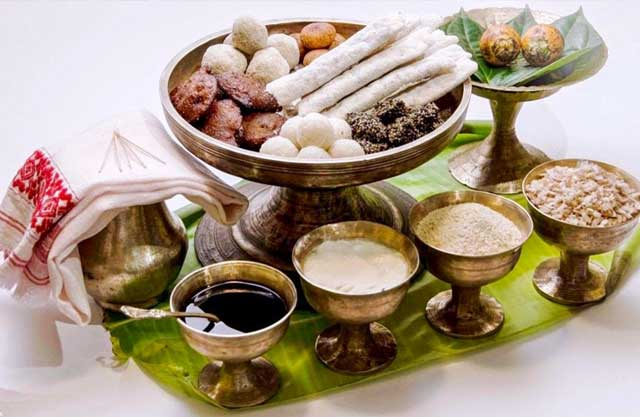 This article on Humans of Northeast India gives a brief survey of Assamese cuisine.
History, Culture, and Politics of Assam
-
 Ethnic Mobilisation and Violence in Northeast India
by
ISBN: 9780415693011Publication Date: 2011-09-11The book is a very detailed work on the relationship between movements for autonomy by indigenous peoples (the so-called 'tribes') and violence in Assam, in northeast India. The book addresses some of the reasons for the failure of ethnic conflict management and for the frequent emergence of violence in the region. In particular, the historical description of movements by the Dimasas, Misings and Bodos is well compiled and provides a good summary for the readers. At the same time, the work offers a good understanding of ethnic violence in contemporary India. The volume offers some new research data based on comparative analysis of different trajectories followed by three important movements among Assam's ethnic minorities. While the pieces of the argument are based on the existing literature on ethnic violence and contentious politics, they are effectively connected to materials drawn from northeast India. Furthermore, the book raises significant concerns on the debates on crafting of decentralised institutions and executive opportunities that may facilitate ethnic accommodation thereby reducing the likelihood of such groups to pursue their goals through channels that are radical or extreme.
Ethnic Mobilisation and Violence in Northeast India
by
ISBN: 9780415693011Publication Date: 2011-09-11The book is a very detailed work on the relationship between movements for autonomy by indigenous peoples (the so-called 'tribes') and violence in Assam, in northeast India. The book addresses some of the reasons for the failure of ethnic conflict management and for the frequent emergence of violence in the region. In particular, the historical description of movements by the Dimasas, Misings and Bodos is well compiled and provides a good summary for the readers. At the same time, the work offers a good understanding of ethnic violence in contemporary India. The volume offers some new research data based on comparative analysis of different trajectories followed by three important movements among Assam's ethnic minorities. While the pieces of the argument are based on the existing literature on ethnic violence and contentious politics, they are effectively connected to materials drawn from northeast India. Furthermore, the book raises significant concerns on the debates on crafting of decentralised institutions and executive opportunities that may facilitate ethnic accommodation thereby reducing the likelihood of such groups to pursue their goals through channels that are radical or extreme. -
 Cultural Forms and Practices in Northeast India
by
ISBN: 9811992916Publication Date: 2023-05-17The present book examines cultural diversities of Northeast India. The sixteen essays included in the volume cover various aspects of cultural forms and their practices among the communities of Northeast. The present volume is expected to serve as a bridge between vanishing cultural forms and their commodification, on the one hand, and their cultural ritual origins, evolution and significance in identity formation, on the other. The book analyses continuity of cultural forms, their representations and often their reinventions under globalisation. Further, the book underlines historical forces such as colonialism and religious conversion that have transformed communities and their cultural practices. Yet some of the pre-colonial, ritual-performative traditions hold on. Through insightful analyses, this book offers an informed view of the region's historical, ethnic and cultural practices. It is expected that the volume will be useful for scholars and students interested in Northeast studies.
Cultural Forms and Practices in Northeast India
by
ISBN: 9811992916Publication Date: 2023-05-17The present book examines cultural diversities of Northeast India. The sixteen essays included in the volume cover various aspects of cultural forms and their practices among the communities of Northeast. The present volume is expected to serve as a bridge between vanishing cultural forms and their commodification, on the one hand, and their cultural ritual origins, evolution and significance in identity formation, on the other. The book analyses continuity of cultural forms, their representations and often their reinventions under globalisation. Further, the book underlines historical forces such as colonialism and religious conversion that have transformed communities and their cultural practices. Yet some of the pre-colonial, ritual-performative traditions hold on. Through insightful analyses, this book offers an informed view of the region's historical, ethnic and cultural practices. It is expected that the volume will be useful for scholars and students interested in Northeast studies. -
Essays on the folklore and culture of north-eastern India by
Writings on folklore and culture of the northeast, focusing on Assam, by noted Assamese novelist Praphulladatta Goswami. -
 Life and Culture in Northeast India
by
ISBN: 9780789213747Publication Date: 2020-11-03The eight states of India's North Eastern Region make up only 8 percent of the country's land mass, but they are home to over one hundred tribes, each with its own unique culture. The terrain, predominantly hilly, ranges from snow-capped Himalayan peaks to tropical rainforests, and the national parks and preserves contain exceptional scenery and an abundance of wildlife, from red pandas to snow leopards. Now, for the first time, noted documentary filmmakers and photographers Dipti Bhalla Verma and Shiv Kunal Verma provide a comprehensive introduction to this little-known yet captivating part of the world. This book provides an extensive look into the histories, cultures, and landscapes that distinguish northeast India. The authors conduct us from the towering Kanchenjunga massif in Sikkim to the tea plantations of Assam, to the astonishing biodiversity of Arunachal Pradesh, to the martial tribes and Baptist churches of Nagaland, to the birthplace of polo in Manipur, to the living root bridges of Meghalaya, to the farms nestled among the hills of Tripura and Mizoram. The authors take us into the lives of the many peoples of northeast India, who maintain their traditional customs and beliefs even in the face of growing ecological threats. Special sections in the book highlight the places that protect the exceptional flora and fauna of this region, including the Manas Wildlife Sanctuary, Khangchendzonga National Park, and Kaziranga National Park. Featuring more than three hundred color photographs and twelve detailed maps, Life and Culture in Northeast India will be an essential volume for anyone interested in the peoples and places of Planet Earth.
Life and Culture in Northeast India
by
ISBN: 9780789213747Publication Date: 2020-11-03The eight states of India's North Eastern Region make up only 8 percent of the country's land mass, but they are home to over one hundred tribes, each with its own unique culture. The terrain, predominantly hilly, ranges from snow-capped Himalayan peaks to tropical rainforests, and the national parks and preserves contain exceptional scenery and an abundance of wildlife, from red pandas to snow leopards. Now, for the first time, noted documentary filmmakers and photographers Dipti Bhalla Verma and Shiv Kunal Verma provide a comprehensive introduction to this little-known yet captivating part of the world. This book provides an extensive look into the histories, cultures, and landscapes that distinguish northeast India. The authors conduct us from the towering Kanchenjunga massif in Sikkim to the tea plantations of Assam, to the astonishing biodiversity of Arunachal Pradesh, to the martial tribes and Baptist churches of Nagaland, to the birthplace of polo in Manipur, to the living root bridges of Meghalaya, to the farms nestled among the hills of Tripura and Mizoram. The authors take us into the lives of the many peoples of northeast India, who maintain their traditional customs and beliefs even in the face of growing ecological threats. Special sections in the book highlight the places that protect the exceptional flora and fauna of this region, including the Manas Wildlife Sanctuary, Khangchendzonga National Park, and Kaziranga National Park. Featuring more than three hundred color photographs and twelve detailed maps, Life and Culture in Northeast India will be an essential volume for anyone interested in the peoples and places of Planet Earth. -
 The Routledge Companion to Northeast India
by
ISBN: 9780367725662Publication Date: 2022-09-30The volume: * Contains authoritative entries from leading specialists from and on the region * Offers clear, concise and illuminating explanations of key themes and ideas * Will contain cross-referenced entries and a bibliographic appendix, detailing the most important works done in relation to each theme * will be an invaluable teaching, learning and research resource for scholars and students of South Asian studies, politics and the social sciences in general
The Routledge Companion to Northeast India
by
ISBN: 9780367725662Publication Date: 2022-09-30The volume: * Contains authoritative entries from leading specialists from and on the region * Offers clear, concise and illuminating explanations of key themes and ideas * Will contain cross-referenced entries and a bibliographic appendix, detailing the most important works done in relation to each theme * will be an invaluable teaching, learning and research resource for scholars and students of South Asian studies, politics and the social sciences in general -
 Northeast India
by
ISBN: 9789351710349Publication Date: 2021-01-01This book is an outcome of the national seminar on the theme Culture Paradigm-The pluralistic Northeast India: Appreciating the Diverse Culture of Northeast India. The papers published in this book identify the paradigm shift in culture which can be seen to be endangering some traditional values that are deeply entrenched in our society. These are the most invaluable parts of the cultural life of the people of northeast India that need to be researched, as we simply cannot afford to lose them. The book brings together the ideas and writings of specialists, including practitioners and academic experts of humanities, literature and social sciences. Their papers explored the cultures of northeast India and affirm cultures and their diversity. They also appreciate their uniqueness and preserve and enhance all that is good and noble in them.
Northeast India
by
ISBN: 9789351710349Publication Date: 2021-01-01This book is an outcome of the national seminar on the theme Culture Paradigm-The pluralistic Northeast India: Appreciating the Diverse Culture of Northeast India. The papers published in this book identify the paradigm shift in culture which can be seen to be endangering some traditional values that are deeply entrenched in our society. These are the most invaluable parts of the cultural life of the people of northeast India that need to be researched, as we simply cannot afford to lose them. The book brings together the ideas and writings of specialists, including practitioners and academic experts of humanities, literature and social sciences. Their papers explored the cultures of northeast India and affirm cultures and their diversity. They also appreciate their uniqueness and preserve and enhance all that is good and noble in them. -
 Cultural Contours of North-East India
by
ISBN: 9780198075578Publication Date: 2012-04-01This book explores aspects of culture and folklore of different states and tribes of north-east India. It examines arts and crafts, regional painting traditions, puppetry, literature, performing arts, cultural relations between different states, and religious cults and movements of the region. The author presents a multifaceted and multilayered cultural heritage of the north-east. Offering an insider's perspective, he highlights the importance of social, political, economic, environmental, emotional, and psychological factors in the formation of culture and folklore. While examining the various tribal cultures and folklores, Birendranath Datta highlights commonalities among the tribal and non-tribal populations. A well-written introduction contextualizes the essays in the current historiography and social scenario. This book will be of considerable interest to scholars and students of culture and folklore studies, sociology, anthropology, and history, particularly those interested in north-east India.
Cultural Contours of North-East India
by
ISBN: 9780198075578Publication Date: 2012-04-01This book explores aspects of culture and folklore of different states and tribes of north-east India. It examines arts and crafts, regional painting traditions, puppetry, literature, performing arts, cultural relations between different states, and religious cults and movements of the region. The author presents a multifaceted and multilayered cultural heritage of the north-east. Offering an insider's perspective, he highlights the importance of social, political, economic, environmental, emotional, and psychological factors in the formation of culture and folklore. While examining the various tribal cultures and folklores, Birendranath Datta highlights commonalities among the tribal and non-tribal populations. A well-written introduction contextualizes the essays in the current historiography and social scenario. This book will be of considerable interest to scholars and students of culture and folklore studies, sociology, anthropology, and history, particularly those interested in north-east India. -
 Where the Sun Rises When Shadows Fall
by
ISBN: 0195682815Publication Date: 2006-07-06This book on India's north east has a broad perspective that deals with the culture, history and literature of individual states along with a political analysis of the region.
Where the Sun Rises When Shadows Fall
by
ISBN: 0195682815Publication Date: 2006-07-06This book on India's north east has a broad perspective that deals with the culture, history and literature of individual states along with a political analysis of the region. -
 Northeast India
by
ISBN: 9781787389526Publication Date: 2023-08-01As India and the world are roiled by questions of nationalism and identity, this book journeys into the history of one of the world's newest and most fascinating regions: Northeast India. Having appeared with the stroke of a pen in 1947, as the British Raj was torn asunder and partitioned into India and Pakistan, this is a region of hills inhabited by myriad tribes. Until colonial rule, they had lived in their ancient ways largely unmolested by their neighbors, who were rather keen to avoid their traditions of head-hunting. Samrat Choudhury chronicles the processes by which these remote hill-tribes, and the diverse other peoples inhabiting the valley of the vast Brahmaputra River below, became parts of the 'imagined nation' that is India. Through the invention of the Northeast, he explores two other ideas of India that remain in daily competition: Bharat, the Hindu nationalist conception of the country, and Hindustan, the Persian-origin name by which India is still known as far west as Turkey. Taking a long view, this absorbing political history chronicles the separate pathways by which imperialism, Christianity and the British love of tea brought each of the contemporary region's constituent states, kicking and screaming, into modern India.
Northeast India
by
ISBN: 9781787389526Publication Date: 2023-08-01As India and the world are roiled by questions of nationalism and identity, this book journeys into the history of one of the world's newest and most fascinating regions: Northeast India. Having appeared with the stroke of a pen in 1947, as the British Raj was torn asunder and partitioned into India and Pakistan, this is a region of hills inhabited by myriad tribes. Until colonial rule, they had lived in their ancient ways largely unmolested by their neighbors, who were rather keen to avoid their traditions of head-hunting. Samrat Choudhury chronicles the processes by which these remote hill-tribes, and the diverse other peoples inhabiting the valley of the vast Brahmaputra River below, became parts of the 'imagined nation' that is India. Through the invention of the Northeast, he explores two other ideas of India that remain in daily competition: Bharat, the Hindu nationalist conception of the country, and Hindustan, the Persian-origin name by which India is still known as far west as Turkey. Taking a long view, this absorbing political history chronicles the separate pathways by which imperialism, Christianity and the British love of tea brought each of the contemporary region's constituent states, kicking and screaming, into modern India. -
 The hour before dawn : a translation of the Assamese novel Antoreep
by
ISBN: 0143063855Publication Date: 2009When Menoka’s dissolute husband Mohikanto takes a second wife she is devastated by the heedless manner in which he squanders her unquestioning loyalty. But after the initial anguish she finds new strength—in her womanhood when she embraces a tender but illicit relationship with a village outcast; in her role as a fiercely protective mother; and, eventually, in a compassionate humanity towards her frail and battered co-wife and needy stepchildren. The story also poignantly explores Menoka’s troubled but ultimately redemptive relationship with Indro, her first-born son, who is unwittingly exposed to a bewildering world of adult complexities and feels compelled to leave the village. Translated from the original Assamese novel Antoreep by renowned writer and film-maker Bhabendra Nath Saikia, The Hour before Dawn is set primarily in pre-Independence India and vividly reflects the intensely verdant life of a small village in Assam. This is a haunting story of conjugal betrayal and retribution, a woman’s hidden strength in her darkest hour and the unforeseen bonds that develop between unlikely people in unexpected circumstances.
The hour before dawn : a translation of the Assamese novel Antoreep
by
ISBN: 0143063855Publication Date: 2009When Menoka’s dissolute husband Mohikanto takes a second wife she is devastated by the heedless manner in which he squanders her unquestioning loyalty. But after the initial anguish she finds new strength—in her womanhood when she embraces a tender but illicit relationship with a village outcast; in her role as a fiercely protective mother; and, eventually, in a compassionate humanity towards her frail and battered co-wife and needy stepchildren. The story also poignantly explores Menoka’s troubled but ultimately redemptive relationship with Indro, her first-born son, who is unwittingly exposed to a bewildering world of adult complexities and feels compelled to leave the village. Translated from the original Assamese novel Antoreep by renowned writer and film-maker Bhabendra Nath Saikia, The Hour before Dawn is set primarily in pre-Independence India and vividly reflects the intensely verdant life of a small village in Assam. This is a haunting story of conjugal betrayal and retribution, a woman’s hidden strength in her darkest hour and the unforeseen bonds that develop between unlikely people in unexpected circumstances. -
 Kayakalpa : the elixir of everlasting youth
by
ISBN: 8189738674Publication Date: 2010Anuj Kripalani is an internationally renowned scientist who apparently has everything—scientific breakthroughs, awards, fame, wealth and a fine family. A deep personal crisis makes him return to India, to rediscover himself and to find out an answer to the question that has always haunted the human race from time immemorial. Anuj thus sets forth on a physical, emotional, spiritual and scientific journey in India. He is reunited with his former sweetheart and finds spiritual solace in his guru. But the answer to the question—the key to rejuvenation—continues to elude him till he finally learns the secret, in which he is helped by a yogi’s Kayakalpa treatment and modern science. While he feels like a creator, sculpting his human subjects anew, unforeseen complications arise. He is caught in a dilemma and has to make a difficult choice. His discovery tests his ethics and ultimately a profound realisation dawns upon him.
Kayakalpa : the elixir of everlasting youth
by
ISBN: 8189738674Publication Date: 2010Anuj Kripalani is an internationally renowned scientist who apparently has everything—scientific breakthroughs, awards, fame, wealth and a fine family. A deep personal crisis makes him return to India, to rediscover himself and to find out an answer to the question that has always haunted the human race from time immemorial. Anuj thus sets forth on a physical, emotional, spiritual and scientific journey in India. He is reunited with his former sweetheart and finds spiritual solace in his guru. But the answer to the question—the key to rejuvenation—continues to elude him till he finally learns the secret, in which he is helped by a yogi’s Kayakalpa treatment and modern science. While he feels like a creator, sculpting his human subjects anew, unforeseen complications arise. He is caught in a dilemma and has to make a difficult choice. His discovery tests his ethics and ultimately a profound realisation dawns upon him. -
 East of the sun : a nearly-stoned walk down the road in a different land
by
ISBN: 9380658362Publication Date: 2010A journalist's vivid account of travels in the interiors of the North-east and the border to Myanmar. Told with wit and humorous perception. Beautifully illustrated with unusual photographs.
East of the sun : a nearly-stoned walk down the road in a different land
by
ISBN: 9380658362Publication Date: 2010A journalist's vivid account of travels in the interiors of the North-east and the border to Myanmar. Told with wit and humorous perception. Beautifully illustrated with unusual photographs. -
 Breaking Barriers in Post-Independence India
by
ISBN: 9781032394046Publication Date: 2023-03-31This book looks at India of the 1950s and 60s while it was still emerging from two centuries of colonial rule and striving to come together as a nation. It critically explores the history of nationalism and identity in Northeastern India, a region with diverse ethnolinguistic communities and people, through the personal history of the first Manipuri (Meitei) direct recruit in the Indian Administrative Services. The book weaves in autobiographical stories with the story of Northeast India, capturing its politics, socio-cultural distinctiveness and milieus that set the region apart from the rest of the country. It covers the career of the author in the IAS, serving in Manipur and Karnataka, with the Union Government, and finally as Secretary for the northeastern region. Through these, the book tells the story of a changing society, of a developing nation and a people on the move. It shows how borders and barriers were collapsing and being formed at the same time and how the country was dealing with it. The book is a unique and significant addition to the literature on Manipur; it deepens our understanding of the northeastern states and the complex interactions of the people of the region with the rest of India. Part of the Transitions in Northeastern India series, this book will be of great interest to researchers and scholars of modern history, sociology, social anthropology and postcolonial studies, particularly those concerned with India and Northeast India.
Breaking Barriers in Post-Independence India
by
ISBN: 9781032394046Publication Date: 2023-03-31This book looks at India of the 1950s and 60s while it was still emerging from two centuries of colonial rule and striving to come together as a nation. It critically explores the history of nationalism and identity in Northeastern India, a region with diverse ethnolinguistic communities and people, through the personal history of the first Manipuri (Meitei) direct recruit in the Indian Administrative Services. The book weaves in autobiographical stories with the story of Northeast India, capturing its politics, socio-cultural distinctiveness and milieus that set the region apart from the rest of the country. It covers the career of the author in the IAS, serving in Manipur and Karnataka, with the Union Government, and finally as Secretary for the northeastern region. Through these, the book tells the story of a changing society, of a developing nation and a people on the move. It shows how borders and barriers were collapsing and being formed at the same time and how the country was dealing with it. The book is a unique and significant addition to the literature on Manipur; it deepens our understanding of the northeastern states and the complex interactions of the people of the region with the rest of India. Part of the Transitions in Northeastern India series, this book will be of great interest to researchers and scholars of modern history, sociology, social anthropology and postcolonial studies, particularly those concerned with India and Northeast India.


Practices around consumption of meat in India vary widely across regions and social groups. India is often touted as having the highest number of vegetarians in the world, but at the same time there is a huge diversity of attitudes towards meat eating and taboos around what can and can't be eaten vary widely. For example, eggs and fish are acceptable to some vegetarians but not all. Muslims avoid pork, which is commonly consumed in some areas, and even non-vegetarian Hindus avoid beef. Of course, individuals may or may not follow the dietary practices of their own groups. But because food is considered such a key marker of community in India, meat eating and vegetarianism can be deeply contested, political spaces. The readings below explore some of these nuances.
In recent years people suspected of eating beef have become victims of mob violence. This phenomenon is known as "cow lynching" and most victims have been Muslim or Dalit. Learn more in this video from The Guardian.
-
 Merchants of Virtue
by
ISBN: 9780520390065Publication Date: 2022-12-27A free ebook version of this title is available through Luminos, University of California Press's Open Access publishing program. Visit www.luminosoa.org to learn more. Winner of the 2022 Joseph W. Elder Prize in the Indian Social Sciences Merchants of Virtue explores the question of what it meant to be Hindu in precolonial South Asia. Divya Cherian presents a fine-grained study of everyday life and local politics in the kingdom of Marwar in eighteenth-century western India to uncover how merchants enforced their caste ideals of vegetarianism and bodily austerity as universal markers of Hindu identity. Using legal strategies and alliances with elites, these merchants successfully remade the category of "Hindu," setting it in contrast to "Untouchable" in a process that reconfigured Hinduism in caste terms. In a history pertinent to understanding India today, Cherian establishes the centrality of caste to the early-modern Hindu self and to its imagination of inadmissible others.
Merchants of Virtue
by
ISBN: 9780520390065Publication Date: 2022-12-27A free ebook version of this title is available through Luminos, University of California Press's Open Access publishing program. Visit www.luminosoa.org to learn more. Winner of the 2022 Joseph W. Elder Prize in the Indian Social Sciences Merchants of Virtue explores the question of what it meant to be Hindu in precolonial South Asia. Divya Cherian presents a fine-grained study of everyday life and local politics in the kingdom of Marwar in eighteenth-century western India to uncover how merchants enforced their caste ideals of vegetarianism and bodily austerity as universal markers of Hindu identity. Using legal strategies and alliances with elites, these merchants successfully remade the category of "Hindu," setting it in contrast to "Untouchable" in a process that reconfigured Hinduism in caste terms. In a history pertinent to understanding India today, Cherian establishes the centrality of caste to the early-modern Hindu self and to its imagination of inadmissible others. -
 Sacred Cows and Chicken Manchurian
by
ISBN: 9780295747873Publication Date: 2020-11-15Challenges popular generalizations about cow protection and beef consumption Bovine politics exposes fault lines within contemporary Indian society, where eating beef is simultaneously a violation of sacred taboos, an expression of marginalized identities, and a route to cosmopolitan sophistication. The recent rise of Hindu nationalism has further polarized traditional views: Dalits, Muslims, and Christians protest threats to their beef-eating heritage while Hindu fundamentalists rally against those who eat the sacred cow. Yet close observation of what people do and do not eat, the styles and contexts within which they do so, and the disparities between rhetoric and everyday action overturns this simplistic binary opposition. Understanding how a food can be implicated in riots, vigilante attacks, and even murders demands that we look beyond immediate politics to wider contexts. Drawing on decades of ethnographic research in South India, James Staples charts how cattle owners, brokers, butchers, cooks, and occasional beef eaters navigate the contemporary political and cultural climate. Sacred Cows and Chicken Manchurian offers a fine-grained exploration of the current situation, locating it within the wider anthropology of food and eating in the region and revealing critical aspects of what it is to be Indian in the early twenty-first century.
Sacred Cows and Chicken Manchurian
by
ISBN: 9780295747873Publication Date: 2020-11-15Challenges popular generalizations about cow protection and beef consumption Bovine politics exposes fault lines within contemporary Indian society, where eating beef is simultaneously a violation of sacred taboos, an expression of marginalized identities, and a route to cosmopolitan sophistication. The recent rise of Hindu nationalism has further polarized traditional views: Dalits, Muslims, and Christians protest threats to their beef-eating heritage while Hindu fundamentalists rally against those who eat the sacred cow. Yet close observation of what people do and do not eat, the styles and contexts within which they do so, and the disparities between rhetoric and everyday action overturns this simplistic binary opposition. Understanding how a food can be implicated in riots, vigilante attacks, and even murders demands that we look beyond immediate politics to wider contexts. Drawing on decades of ethnographic research in South India, James Staples charts how cattle owners, brokers, butchers, cooks, and occasional beef eaters navigate the contemporary political and cultural climate. Sacred Cows and Chicken Manchurian offers a fine-grained exploration of the current situation, locating it within the wider anthropology of food and eating in the region and revealing critical aspects of what it is to be Indian in the early twenty-first century. -
 Vegetarianism, Meat and Modernity in India
by
ISBN: 9781032334837Publication Date: 2023-04-07Never before in human history have vegetarianism and a plant-based economy been so closely associated with sustainability and the promise of tackling climate change. Nowhere is this phenomenon more visible than in India, which is home to the largest number of vegetarians globally and where vegetarianism is intrinsic to Hinduism. India is often considered a global model for vegetarianism. However, in this book, which is the outcome of eight months of fieldwork conducted among vegetarian and non-vegetarian producers, traders, regulators and consumers, I show that the reality in India is quite different, with large sections of communities being meat-eaters. In 2011, vegetarian/veg/green and nonvegetarian/ non-veg/brown labels on all packaged foods/drinks were introduced in India. Paradoxically, this grand scheme was implemented at a time when meat and non-vegetarian food production, trade and consumption were booming. The overarching argument of the book is that a systematic study of the complex and changing relationship between vegetarian and non-vegetarian understandings and practices illuminates broader transformations and challenges that relate to markets, the state, religion, politics and identities in India and beyond. The book's empirical focus is on the changing relationship between vegetarian/ non-vegetarian as understood, practised and contested in middle-class India, while remaining attentive to the vegetarian/non-vegetarian modernities that are at the forefront of global sustainability debates. Through the application of this approach, the book provides a novel theory of human values and markets in a global middle-class perspective.
Vegetarianism, Meat and Modernity in India
by
ISBN: 9781032334837Publication Date: 2023-04-07Never before in human history have vegetarianism and a plant-based economy been so closely associated with sustainability and the promise of tackling climate change. Nowhere is this phenomenon more visible than in India, which is home to the largest number of vegetarians globally and where vegetarianism is intrinsic to Hinduism. India is often considered a global model for vegetarianism. However, in this book, which is the outcome of eight months of fieldwork conducted among vegetarian and non-vegetarian producers, traders, regulators and consumers, I show that the reality in India is quite different, with large sections of communities being meat-eaters. In 2011, vegetarian/veg/green and nonvegetarian/ non-veg/brown labels on all packaged foods/drinks were introduced in India. Paradoxically, this grand scheme was implemented at a time when meat and non-vegetarian food production, trade and consumption were booming. The overarching argument of the book is that a systematic study of the complex and changing relationship between vegetarian and non-vegetarian understandings and practices illuminates broader transformations and challenges that relate to markets, the state, religion, politics and identities in India and beyond. The book's empirical focus is on the changing relationship between vegetarian/ non-vegetarian as understood, practised and contested in middle-class India, while remaining attentive to the vegetarian/non-vegetarian modernities that are at the forefront of global sustainability debates. Through the application of this approach, the book provides a novel theory of human values and markets in a global middle-class perspective. -
 A Taste for Purity
by
ISBN: 9780231207522Publication Date: 2023-12-05In nineteenth-century Europe and North America, an organized vegetarian movement began warning of the health risks and ethical problems of meat eating. Presenting a vegetarian diet as a cure for the social ills brought on by industrialization and urbanization, this movement idealized South Asia as a model. In colonial India, where diets were far more varied than Western admirers realized, new motives for avoiding meat also took hold. Hindu nationalists claimed that vegetarianism would cleanse the body for anticolonial resistance, and an increasingly militant cow protection movement mobilized against meat eaters, particularly Muslims. Unearthing the connections among these developments and many others, Julia Hauser explores the global history of vegetarianism from the mid-nineteenth century to the early Cold War. She traces personal networks and exchanges of knowledge spanning Europe, the United States, and South Asia, highlighting mutual influence as well as the disconnects of cross-cultural encounters. Hauser argues that vegetarianism in this period was motivated by expansive visions of moral, physical, and even racial purification. Adherents were convinced that society could be changed by transforming the body of the individual. Hauser demonstrates that vegetarians in India and the West shared notions of purity, which drew some toward not only internationalism and anticolonialism but also racism, nationalism, and violence. Finding preoccupations with race and masculinity as well as links to colonialism and eugenics, she reveals the implication of vegetarian movements in exclusionary, hierarchical projects. Deeply researched and compellingly argued, A Taste for Purity rewrites the history of vegetarianism on a global scale.
A Taste for Purity
by
ISBN: 9780231207522Publication Date: 2023-12-05In nineteenth-century Europe and North America, an organized vegetarian movement began warning of the health risks and ethical problems of meat eating. Presenting a vegetarian diet as a cure for the social ills brought on by industrialization and urbanization, this movement idealized South Asia as a model. In colonial India, where diets were far more varied than Western admirers realized, new motives for avoiding meat also took hold. Hindu nationalists claimed that vegetarianism would cleanse the body for anticolonial resistance, and an increasingly militant cow protection movement mobilized against meat eaters, particularly Muslims. Unearthing the connections among these developments and many others, Julia Hauser explores the global history of vegetarianism from the mid-nineteenth century to the early Cold War. She traces personal networks and exchanges of knowledge spanning Europe, the United States, and South Asia, highlighting mutual influence as well as the disconnects of cross-cultural encounters. Hauser argues that vegetarianism in this period was motivated by expansive visions of moral, physical, and even racial purification. Adherents were convinced that society could be changed by transforming the body of the individual. Hauser demonstrates that vegetarians in India and the West shared notions of purity, which drew some toward not only internationalism and anticolonialism but also racism, nationalism, and violence. Finding preoccupations with race and masculinity as well as links to colonialism and eugenics, she reveals the implication of vegetarian movements in exclusionary, hierarchical projects. Deeply researched and compellingly argued, A Taste for Purity rewrites the history of vegetarianism on a global scale. -
 Meat, Mercy, Morality
by
ISBN: 9780190129132Publication Date: 2021-11-09This book disentangles complex discourses around humanitarianism to understand the nature of British colonialism in India. It contends that the colonial project of animal protection in late nineteenth-century Bengal mirrored an irony. Emerging notions of public health and debates on cruelty against animals exposed the disjunction between the claims of a benevolent Empire and a powerful imperial reality where the state constantly sought to discipline its subjects-both human and nonhuman. Centered around stories of animals as diseased, eaten, and overworked, the book shows how such contests over appropriate measures for controlling animals became part of wider discussions surrounding environmental ethics, diet, sanitation, and the politics of race and class. The author combines history with archive, arguing that colonial humanitarianism was not only an idiom of rule, but was also translated into Bengali dietetics, anxieties, vegetarianism, and vigilantism, the effect of which can be seen in contemporary politics of animal slaughter in India.
Meat, Mercy, Morality
by
ISBN: 9780190129132Publication Date: 2021-11-09This book disentangles complex discourses around humanitarianism to understand the nature of British colonialism in India. It contends that the colonial project of animal protection in late nineteenth-century Bengal mirrored an irony. Emerging notions of public health and debates on cruelty against animals exposed the disjunction between the claims of a benevolent Empire and a powerful imperial reality where the state constantly sought to discipline its subjects-both human and nonhuman. Centered around stories of animals as diseased, eaten, and overworked, the book shows how such contests over appropriate measures for controlling animals became part of wider discussions surrounding environmental ethics, diet, sanitation, and the politics of race and class. The author combines history with archive, arguing that colonial humanitarianism was not only an idiom of rule, but was also translated into Bengali dietetics, anxieties, vegetarianism, and vigilantism, the effect of which can be seen in contemporary politics of animal slaughter in India.


Gahori Mankho: Assamese Pork Belly Curry
Pork is a less common meat in India, but we chose to highlight it here in keeping with the theme of the film. Here, pork belly cooks in its own fat for a decadent and extremly flavorful main dish often found at festivals such as Magh Bihu.
Ingredients:
1lb pork belly in 1 inch cubes
1 medium red onion, thinly sliced
2 tbsp ginger-garlic paste
3-4 green chilis (adjust to taste)
1 tsp turmeric powder
2 tsp meat masala (find it at your local Indian grocery, or substitute garam masala)
2 tsp red chili powder (adjust to taste
1 tsp salt (adjust to taste)
2 tomatoes, chopped or grated
Chopped cilantro for garnish
Method:
1. Add pork belly to a hot kadhai (or wok) and cover to render for 5-6 minutes on medium heat, stirring a few times.
2. Stir in onion; when it is softened, lower heat and stir in ginger-garlic paste. Cook for 2-3 minutes, stirring periodically.
3. Add green chilis, turmeric, meat masala, red chili powder, and salt. Cook for five to ten more minutes, stirring and scraping the bottom of the pot as needed, until the oil begins to separate from the spices.
4. Add tomatoes and cook uncovered on medium-low heat until the tomatoes begin to soften.
5. Add 1 cup water and stir, scraping the browned bits from the bottom of the pan; cover and cook for 20 more minutes.
6. Garnish with chopped cilantro and serve with rice.
